
If you have sourced agricultural ventilation fans before, you have probably seen this happen: a supplier promises "100% corrosion-resistant fiberglass." The fans look shiny when you unload the shipment. Two years later, the outer cones are chalky, brittle, and cracking around the bolt holes, while the internal brackets are eaten through by rust.
Replacing a failed exhaust fan in an active livestock house isn't just about the price of a new fan. It means paying freight again, tearing out wall framing between batches, and risking severe heat stress if a fan goes down during peak summer.
1. Two Operating Conditions That Destroy Ordinary Fans
Equipment that survives for years in a mild warehouse often fails in less than two seasons under demanding agricultural conditions:
- High-Ammonia Swine & Poultry Houses: Slatted-floor pig barns and high-density poultry facilities combine 80%+ relative humidity with constant ammonia (NH3) and hydrogen sulfide (H2S). Between batches, crews hit the fans with high-pressure water jets and caustic disinfectants. Thin galvanized steel rusts rapidly at the seams, and unsealed motors burn out from moisture ingress.
- Intense Outdoor UV & High Ambient Heat: When exterior discharge cones bake year-round under strong solar ultraviolet radiation and high summer temperatures, cheap polyester resins break down rapidly—turning brittle like an eggshell until wind vibration snaps the cone.
2. The Industry Secret: "Hand-Laid FRP" vs. "SMC Molded FRP"
Why can one factory quote an "FRP fan" for $40 less than another? Because "FRP" (Fiberglass Reinforced Plastic) is a catch-all term for two completely different manufacturing processes.
| Inspection Point | Low-Cost "Hand-Laid" FRP (Manual Layup) | Industrial "SMC Molded" FRP (Steel Die Compression) |
|---|---|---|
| How It Is Made | Workers brush liquid resin onto fiberglass mats by hand over a simple mold and let it cure at room temperature. | Sheet Molding Compound (SMC) is pressed in heavy-tonnage heated steel dies under high pressure and temperature. |
| How to Spot It by Touch | Smooth only on the outside; the inside surface is rough with visible glass fibers and uneven wall thickness. | Smooth, dense, and porcelain-like on both the inside and outside, with exact millimeter thickness everywhere. |
| What Happens After 2 Years | Air bubbles trapped inside expand under heat; UV rays peel the surface coat; bolt holes crack under vibration. | High fiberglass density and UV-stabilized resin resist solar weathering, chemical washdowns, and structural fatigue for 10+ years. |
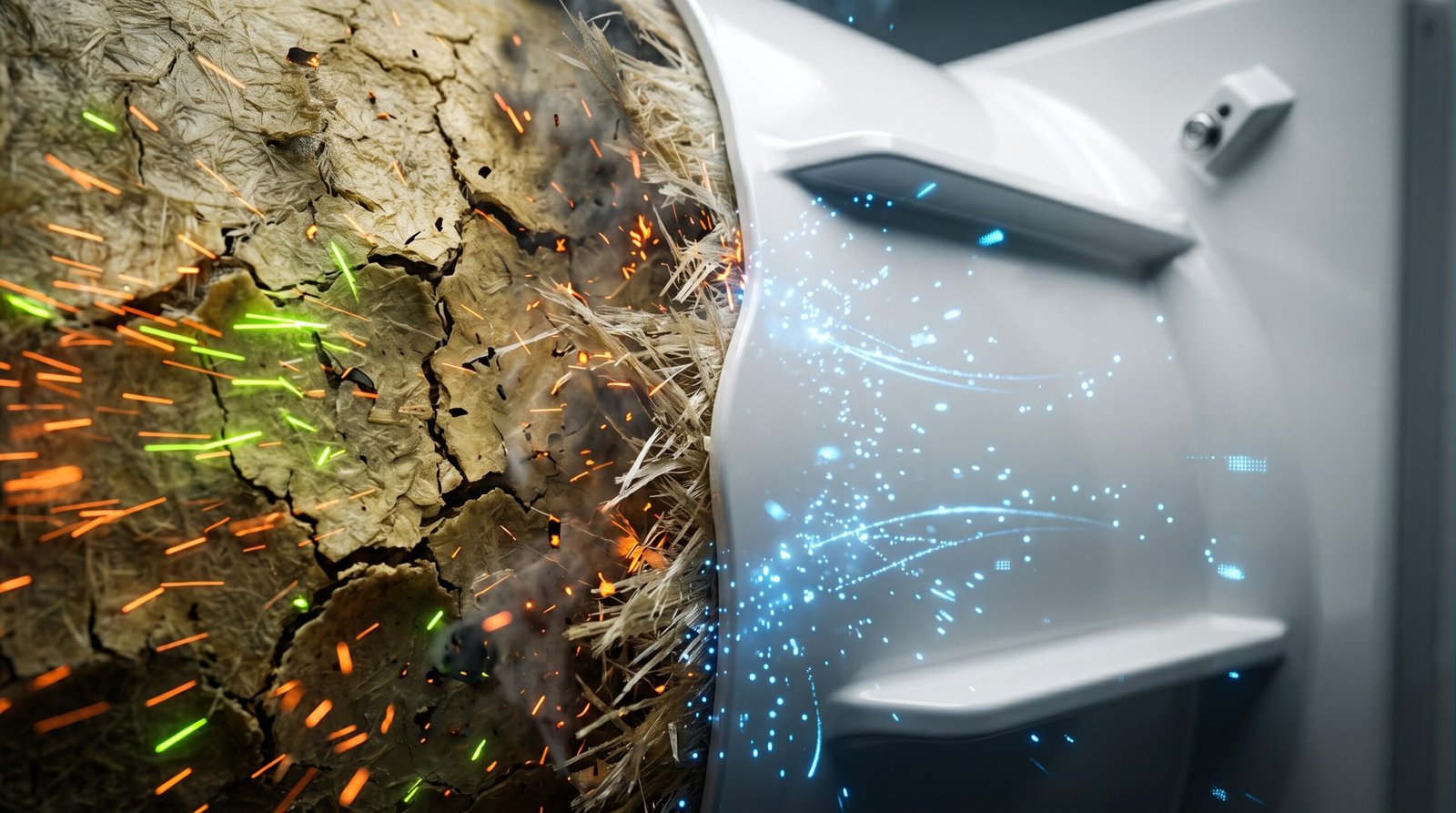
3. A Strong Shell Is Useless If the Internal Hardware Rusts
Even a genuine SMC fiberglass housing won't save you if the factory cuts corners on the internal components. When inspecting a sample or reviewing a quote for humid or corrosive farms, check these three weak points:
- Motor Ingress Protection (IP55 / IP66): In houses that undergo high-pressure washing between flocks, standard open-drip motors fail fast. Insist on sealed IP55 or IP66 motors with class F/H insulation that can handle direct washdown moisture and ambient heat.
- Impeller Blades & Balancing: Molded FRP blades or heavy-duty corrosion-resistant blades never rust like stamped iron blades. Just as important, every impeller should undergo dynamic balancing before assembly so it doesn't shake the motor bearings apart.
- Shutters & Fasteners: Gravity PVC shutters must be compounded with UV stabilizers so louvers don't warp or jam open under sunlight. Internal bolts and safety guards should use stainless steel or heavy hot-dip corrosion protection.
4. Where Do Galvanized Steel Cone Fans Still Fit?
Does this mean galvanized steel fans are obsolete? Not at all—if they are used in the right place. For dry-climate broiler houses, commercial greenhouses, or industrial workshops where ammonia corrosion is low and maximum airflow per dollar is the priority, a heavy-gauge 52" Galvanized Butterfly Cone Fan remains a highly practical, cost-effective choice. The key is matching the material to the building's actual chemical environment.