
Anyone who has managed a large-scale poultry or swine operation knows the real headache isn't buying the fans. It's paying the monthly electricity bill—and sending maintenance crews up a ladder in peak summer heat to tighten loose V-belts.
When contractors price out a new project, it is tempting to shave $30 or $40 off per unit by choosing a conventional belt-driven fan or a lower-grade motor. On a purchase order for 40 fans, that looks like a quick saving. On the farm's actual ledger over the next 12 months, it is usually the most expensive mistake a buyer can make.
1. The Brutal Math of 6,000 Operating Hours a Year
In high-density commercial operations—especially in warm climates or year-round tunnel-ventilated barns—exhaust fans run 16 to 20 hours a day across most of the year. That easily adds up to 6,000 operating hours annually.
Global commercial agricultural electricity tariffs frequently average $0.13 to $0.20 per kWh. And whenever severe weather or peak grid demand forces a farm onto backup diesel generators, the real cost of generated power jumps past $0.28 to $0.35 per kWh.
| Cost Metric (Per 50"–55" Fan) | Conventional AC Belt-Driven Fan | High-Efficiency Direct-Drive (IE5 EC / IE3 AC) |
|---|---|---|
| Real Input Power Under Load | ~1.50 kW (including belt & pulley friction losses) | ~1.10 kW (direct shaft coupling + variable speed) |
| Annual Run Time (High-Load Barn) | 6,000 Hours / Year | 6,000 Hours / Year |
| Annual Power Bill (@ $0.15/kWh) | $1,350 USD / year per fan | $990 USD / year per fan |
| Annual Power Bill for 1 House (20 Fans) | $27,000 USD / year | $19,800 USD / year (Saves $7,200/yr) |
Look closely at those numbers: a single exhaust fan eats $1,000 to $1,350 worth of electricity every single year—more than three times the purchase price of the fan itself. Saving just 0.4 kW per fan cuts $360 off the annual power bill per unit, or $7,200 a year for a single 20-fan poultry house. The price difference between a basic fan and a high-efficiency direct-drive fan pays for itself in less than one production cycle.
2. The Silent Thief: What Belt Slippage Actually Costs You
People often assume a belt-driven fan delivers the same airflow in Month 6 as it did on Day 1. In reality, rubber V-belts stretch and wear down fast in warm, dusty, humid livestock houses.
Even a slightly loose belt slips on the pulley under 25–35 Pa of static pressure. A 15% drop in impeller RPM doesn't just cut your airflow by 15–20%; it also kills your house wind speed during peak afternoon heat. Worse yet, the electric motor still draws nearly full amperage. You are paying the utility company for air that never moves through your barn.
On a farm running 100 belt-driven fans across five houses, keeping belts properly tensioned, replacing worn bearings, and realigning pulleys is a never-ending maintenance burden. If the farm crew skips belt checks for two months, bird weights drop and mortality creeps up at the exhaust end of the house.
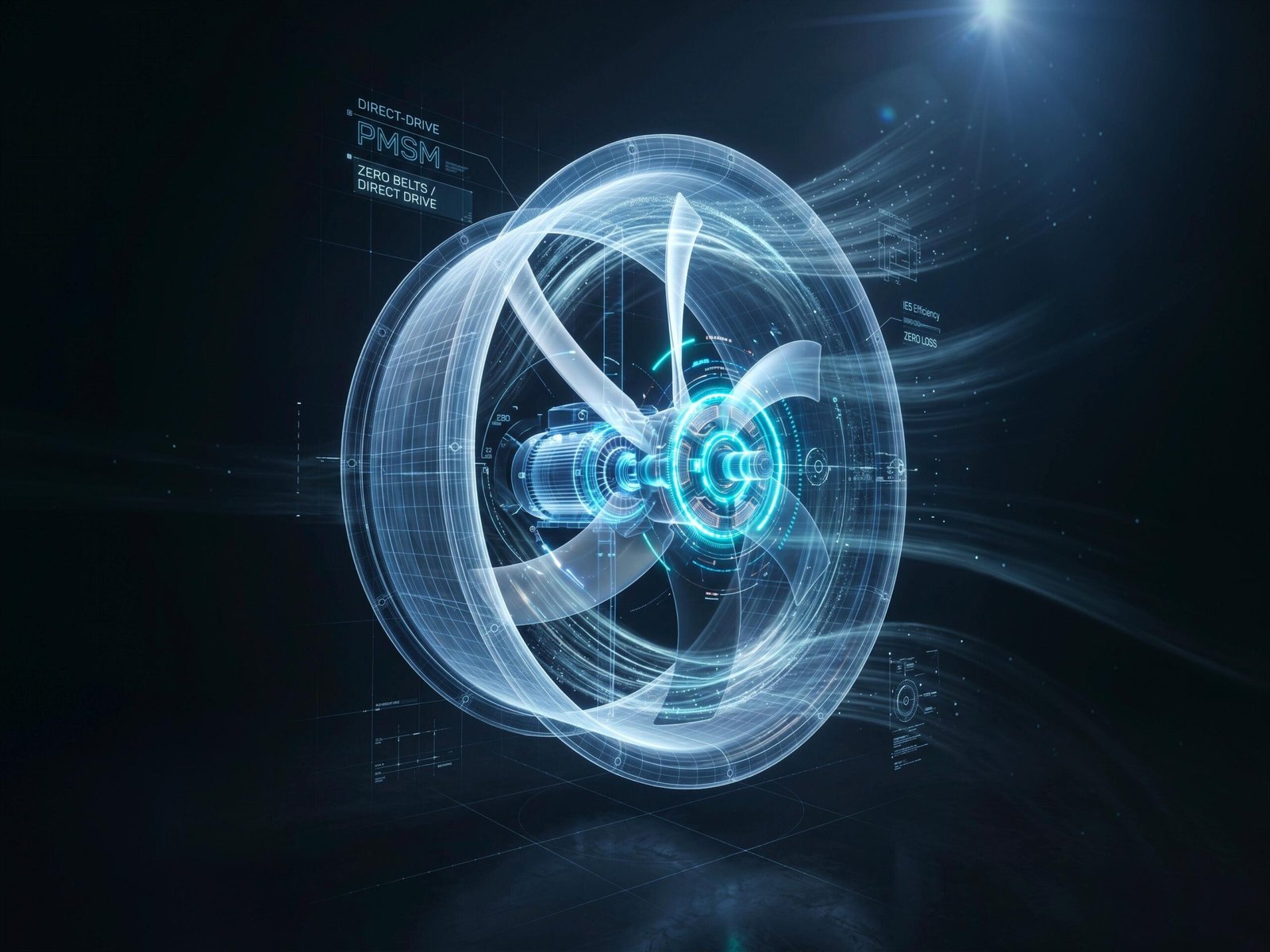
3. Why Direct-Drive EC and IE3 Motors Make Engineering Sense
Switching to a direct-drive configuration—where the impeller mounts directly onto the motor shaft—solves two problems at once:
- Zero Mechanical Transmission Loss: Every watt of motor output goes directly into turning the blades. There are no belts to stretch, no pillow-block bearings to grease, and no pulleys to rust.
- Soft Start & Generator Friendly (EC Series): Traditional AC motors create a massive inrush current spike (5x to 7x rated current) when starting up. Direct-drive EC (IE5 PMSM) fans ramp up smoothly with zero current surge, reducing peak demand charges and allowing farms to run on smaller backup generators.
- Variable Speed Without External Inverters: During cool nights or brooding stages, dimming a 50" EC fan down to 60% speed cuts power consumption by nearly half, while keeping air exchange steady.
4. When Should You Choose EC vs. Direct-Drive AC?
Both platforms eliminate belt maintenance, but they fit different project budgets and operating strategies:
- Choose IE5 EC Fiberglass Fans (50" / 57") if your electricity tariff is above $0.12/kWh, if you rely on backup generators, or if you need one fan bank to handle both low-speed transitional ventilation and full-speed tunnel cooling.
- Choose IE3 Direct-Drive AC Fans (24" to 55") if you want a rock-solid, zero-belt-maintenance workhorse for dedicated tunnel banks that run at 100% speed all day, with a lower upfront purchase cost.