
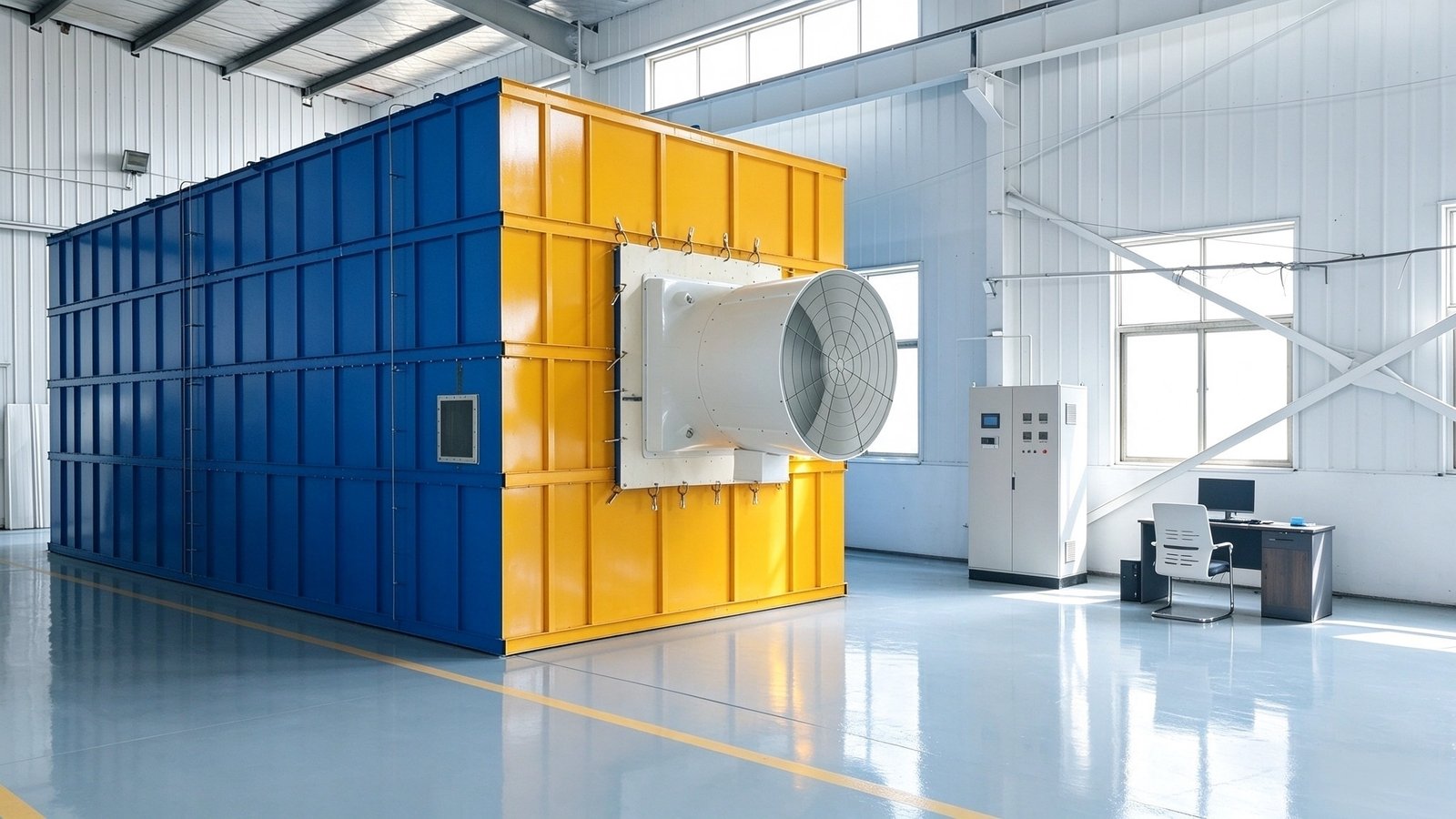
Here is an open secret in the agricultural fan manufacturing industry: out of hundreds of fan suppliers on the market, fewer than 5% actually own a full-scale wind tunnel testing laboratory.
So where do the other 95% of assembly workshops get the airflow numbers printed on their brochures? Usually by copying a competitor's datasheet and typing a bigger number into the Excel file. After all, printing "58,000 m³/h" on a PDF costs nothing.
For an equipment distributor, turnkey contractor, or commercial farm owner anywhere in the world, falling for "paper airflow" is the fastest way to ruin a ventilation project.
1. What Happens When a "0 Pa" Fan Hits a Real Cooling Pad?
Almost every unverified quote sheet highlights a single number: maximum airflow at 0 Pa (free air)—meaning the fan is blowing in an open room with zero resistance.
But the moment you close the doors of a poultry or swine house and pull air through 150mm evaporative cooling pads, light traps, and shutters, the fan is fighting 25 Pa to 50 Pa of negative static pressure. On an untested fan with poor blade pitch or wide tip clearance, airflow doesn't just dip at 35 Pa—it falls off a cliff.
2. How Saving $25 Per Fan Ends Up Costing 30% More
Let's run a real procurement scenario. Suppose your poultry house requires 420,000 m³/h of actual airflow at 35 Pa static pressure to keep birds safe during a summer heatwave:
| Project Cost Breakdown | Supplier A: Unverified "Bargain" Fan | Supplier B: Wind-Tunnel Verified Fan |
|---|---|---|
| Claimed Airflow on Brochure (0 Pa) | "50,000 m³/h" (Untested paper claim) | 48,000 m³/h (Lab verified) |
| Actual Delivered Airflow at 35 Pa | Drops to 30,000 m³/h under pad resistance | Holds 42,000 m³/h (Verified in wind tunnel) |
| Fans Needed to Hit 420,000 m³/h | 14 Fans Required per house | 10 Fans Required per house |
| Hidden Penalty You Pay | You buy 4 extra fans, cut 4 extra wall holes, pay 40% more ocean freight, and pay 4 extra electricity bills for 10 years. | True lowest cost per 1,000 m³/h of real delivered air. |
Smart contractors don't buy exhaust fans by the piece—they buy verified cubic meters of air per dollar at 25–50 Pa. Buying 10 fans that actually deliver their rated curve is always cheaper than buying 14 cheap fans that choke under pressure.
3. The Second Cost Killer: Ocean Freight & 40HQ Container Loading
For international buyers, ocean freight can add 15% to 30% to the landed cost of bulky ventilation equipment. Fully assembled cone fans ship mostly "air" inside a container.
To keep your landed cost per fan highly competitive without sacrificing material quality, confirm how the equipment is engineered for global export:
- High-Density CKD / SKD Packing: Precision-molded SMC housings and cones stack cleanly on export pallets, allowing significantly more units to fit inside a single 40HQ container and slashing sea freight cost per unit.
- Fast On-Site Assembly: Because SMC parts are compression-molded in steel dies rather than laid by hand, every bolt hole lines up cleanly at the job site—saving your installation crew days of frustration.
- Global Voltage & Frequency Matching: Whether your local grid runs on 380V/400V/415V at 50Hz, or 220V/230V/460V at 60Hz, motors are wound and tested specifically for your facility before crating.